Health, protection, water, livelihoods, and safe spaces for women. In northern Ethiopia, years of conflict have left needs that remain very much a part of daily life. In Tigray, Amhara, and Afar, Farmamundi works alongside two local organizations on initiatives involving more than 80,000 people. These are concrete actions to ensure access to healthcare and safe drinking water, protect against violence, restore livelihoods, and move toward greater self-reliance.
Northern Ethiopia continues to face the consequences of the Tigray conflict and its spread to Amhara and Afar. Forced displacement, the deterioration of health services, and violence against women and girls continue to shape the lives of many communities. According to the United Nations Population Fund, 2.5 million women and girls need sexual and reproductive health services this year.
In Afar, moreover, the earthquake that struck Berhale in 2025 exacerbated the needs of the refugee population and host families. Currently, the country is hosting more than one million refugees and asylum seekers, mainly from South Sudan, Somalia, and Eritrea, of whom 47% are women and girls, according to UNHCR data.
With a presence in Tigray, Amhara, and Afar
Our response is being carried out in Samre and Seharti, in Tigray; South Wollo, North Wollo, Waghimra, and Dessie, in Amhara; and Berhale, in Afar. We carry out this work in partnership with two Ethiopian organizations, Women Empowerment-Action (WE-Action) and Africa Humanitarian Action (AHA), and with the support of Farmamundi’s technical team in the country—Alba Iglesias and Félix Carrasco—who assist with the fieldwork.
Restoring Health and Autonomy
Ensuring that a hospital has medications. Ensuring that a woman who is a survivor of violence receives specialized care. Ensuring that a family can once again have access to safe water. These are some of the initiatives currently underway.
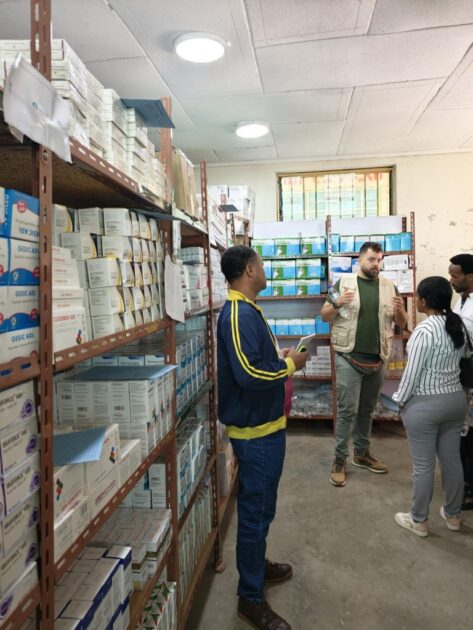
Farmamundi supplies medicines and equipment to hospitals and public health centers and strengthens primary care in the areas most affected by conflict and displacement.
Health also involves addressing the consequences of violence. “Together with our local partners, we support women and girls who are survivors of sexual and gender-based violence by providing healthcare, mental health care, and psychosocial support. The One-Stop Centers allow us to bring together different services in a single space, along with initiatives such as dignity kits and ‘cash for health’ assistance,” says Alba Iglesias.
Recovery continues outside the health center. “We support returning women, displaced women, and survivors of violence so they can generate their own income, through agricultural training, cash transfers, and support for farming and livestock raising. We also rehabilitate water sources, promote community-based management of these resources, and distribute hygiene kits, including menstrual hygiene products,” Iglesias continues.
From Samre to Berhale
In Samre, Tigray, all these elements come together: public hospital supply, care for survivors of violence, cash-for-health programs, livelihood recovery, and the rehabilitation of water points. This approach also extends to Seharti and Dessie.
In Berhale, Afar, the response launched following the conflict and the earthquake will continue through 2027. “Together with AHA, we are working on primary care, medications, psychosocial support, protection, water, hygiene, and community participation. Collaborative and ongoing work with the communities themselves is essential,” explains Félix Carrasco.
Stronger humanitarian action
Keeping these initiatives going is more difficult at a time when global humanitarian funding is declining.
Alba Iglesias warns of what this means in places where needs persist: “Far from being a mere technical cutback, this reduction in global funding that we are experiencing exacerbates the situation of those already living in persistent crises and in situations of extreme vulnerability, fuels instability —Ethiopia is a clear example—and drags NGOs into a relentless competition in which we end up having to justify why one life is worth as much as another.”
That is why, at Farmamundi, we advocate for a more robust, stable, and adequate humanitarian response that allows us to support recovery efforts for as long as necessary. As Alba points out, “it is urgent to build fairer systems for distributing funds, guided by humanitarian principles rather than by the media visibility they may generate.”
Currently, Farmamundi’s work in Ethiopia through seven projects is supported by the Spanish Agency for International Development Cooperation (AECID), the Valencian Regional Government, the Basque Agency for Cooperation and Solidarity, the Catalan Agency for Development Cooperation (ACCD), the Provincial Council of Bizkaia, the Andalusian Agency for International Development Cooperation (AACID), and the Regional Government of Galicia, in addition to Farmamundi’s own funds, which make it possible to sustain our interventions alongside our local partners.
SOURCE: Farmamundi